Rock Bottom as a Starting Gun: Five Americans Whose Worst Day Launched Everything

We love a comeback story. American culture is practically built on them. But there's a version of the redemption narrative that's more interesting — and more honest — than the standard arc of fall, struggle, and triumphant return. Sometimes the catastrophe isn't just a detour on the way back to where you were heading. Sometimes it's a door to somewhere else entirely. Somewhere better. Somewhere you would never have found any other way.
These five Americans didn't just survive their worst days. Their worst days, it turned out, were the whole point.
1. The Fired Schoolteacher Who Accidentally Invented American Children's Television
In 1951, a young teacher named Frances Horwich was let go from her position at a Chicago elementary school during a round of budget cuts. She was thirty-eight, had spent her career in education, and had no particular plan for what came next. She applied for a job at a local radio station almost as a joke — a friend had mentioned they were looking for someone who could talk to kids. Horwich figured she'd do it until something better came along.
What came along was a television camera.
Horwich became the host of Ding Dong School, one of the first educational programs for young children in American television history. She didn't perform for children. She talked to them — directly, warmly, as if they were sitting in her actual classroom. The show ran on NBC from 1952 to 1956 and was watched by millions of families across the country. It established a template for children's educational television that shaped everything from Mister Rogers' Neighborhood to Sesame Street.
Horwich spent the rest of her career writing, lecturing, and advising on child development through media. She became a genuine authority on how television could be used to educate rather than just distract young viewers.
None of it happens without the budget cut. The classroom she was fired from held thirty kids. The classroom she found on television held a generation.
2. The Bankruptcy That Built the American Theme Park
Everybody knows Walt Disney built Disneyland. Fewer people know that the specific vision for Disneyland — the coherent, immersive, narrative-driven experience that revolutionized the entertainment industry — emerged directly from the most painful professional period of Disney's career.
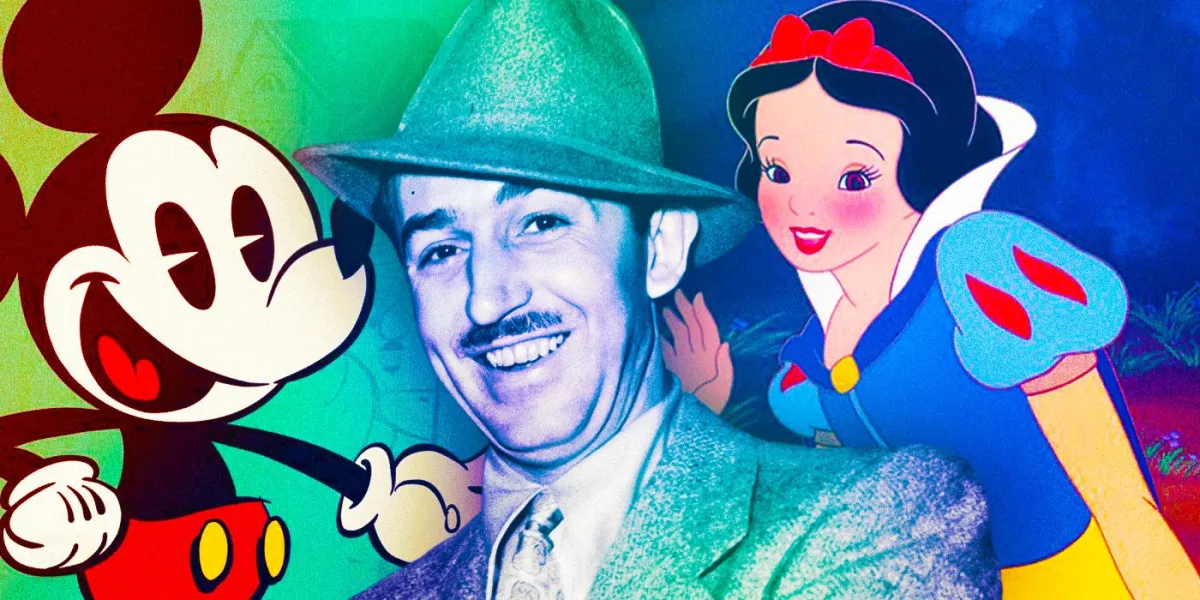 Photo: Walt Disney, via static1.srcdn.com
In the early 1940s, a bitter labor strike at his studio, followed by the commercial disappointment of several ambitious animated features, left Disney financially stretched and creatively demoralized. The studio nearly collapsed. Disney himself described the period as one of the lowest of his life. He became withdrawn, anxious, and for a stretch of time genuinely unsure whether the studio would survive.
During that low period, Disney started visiting amusement parks with his daughters. He hated them — the grime, the disconnected rides, the sense that nothing added up to anything. He began sketching, almost obsessively, a different kind of place. A place where every element would reinforce a story. Where the design itself would create a feeling of being inside a world rather than just walking through a fairground.
The strike and the financial crisis forced Disney to think differently about his business. He couldn't just make films and hope they worked. He needed a new model. The suffering of those years drove him toward an idea that the comfortable, successful version of himself might never have needed to pursue.
Disneyland opened in 1955. It changed not just entertainment but architecture, urban planning, and how Americans thought about designed experience. The blueprint was drawn in the dark.
3. The Disgraced Scientist Who Saved American Crops
In 1904, a plant scientist named Marion Dorset was publicly embarrassed when a research project he had championed — an attempt to develop a vaccine for a devastating hog disease — was declared a failure by his supervisors at the Bureau of Animal Industry. The work was shelved. Dorset was quietly reassigned to what amounted to a bureaucratic dead end.
Fuming and sidelined, Dorset kept working on the problem on his own time, with minimal resources and no institutional support. Two years later, he and a small team of colleagues cracked it. They developed the first effective vaccine for hog cholera — a disease that had been devastating American pig populations for decades and costing farmers hundreds of millions of dollars in losses.
The vaccine transformed American agriculture. Pork production, which had been chronically destabilized by the disease, became far more reliable. The economic ripple effects were enormous. Dorset eventually received belated recognition, but the real story is what the humiliation gave him: the freedom to work without oversight, without institutional pressure, and without the need to produce results on anyone else's schedule.
The reassignment that was meant to neutralize him turned out to be the condition he needed to do the most important work of his life.
4. The Collapsed Marriage That Built an Empire of Self-Help
In the late 1960s, a Detroit-area housewife named Mary Ellen Pinkham found herself newly divorced, broke, and raising children largely on her own. She had no college degree, no professional experience, and no obvious path forward. What she had was an almost compulsive habit of collecting practical tips — household tricks, cleaning shortcuts, cooking hacks — that she had been accumulating in notebooks for years.
Out of desperation more than inspiration, she started compiling those notes into a self-published guide that she sold locally. It sold better than she expected. She kept going. By the 1970s, Pinkham had become one of the most successful self-help authors in America, eventually selling millions of copies of her Mary Ellen's Best of Helpful Hints series, which became a staple of American households for decades.
Her publishing empire — built from index cards, lived experience, and the specific practical knowledge that comes from running a home without much money or help — would never have existed without the divorce. She wasn't pivoting from a career. She had no career to pivot from. The catastrophe was the beginning, full stop.
The notebooks she kept during her marriage became the product. The crisis that ended that marriage gave her a reason to share them.
5. The Medical School Rejection That Produced a Public Health Revolution
In 1913, a young man named Joseph Goldberger was rejected by the medical school of his first choice and accepted, with some reluctance on both sides, by a less prestigious institution. Stung by the rejection, he threw himself into his studies with an intensity that surprised his professors and, eventually, a research career that took him to the U.S. Public Health Service.
There, assigned to investigate a mysterious disease called pellagra that was devastating poor communities across the American South, Goldberger did something that the medical establishment had been unwilling to do: he went and lived among the people who were sick. He ate their food. He sat in their homes. He listened to them.
His conclusion — that pellagra was caused not by an infection but by nutritional deficiency, specifically a lack of niacin in a diet dominated by corn — was ridiculed by the scientific mainstream for years. Goldberger ran clinical trials, including some that were ethically questionable by modern standards but scientifically rigorous for the era, and proved his case beyond reasonable doubt.
The public health interventions that followed saved hundreds of thousands of lives. Goldberger's work also established the principle that disease patterns in poor communities often reflect social and economic conditions rather than individual behavior or biological predisposition — an insight that shaped American public health policy for the rest of the century.
He never forgot the rejection. His colleagues later said it made him permanently suspicious of institutional authority and permanently committed to looking for answers in places prestigious institutions didn't think to look.
The slight that shaped him was, in the end, the thing that made him see what everyone else missed.
The Pattern Behind the Stories
What connects these five people isn't resilience, exactly — though they all had plenty of it. What connects them is something stranger and more specific: in each case, the failure removed a constraint. A door closed, and the closing of that door turned out to be the only thing that could have opened the next one.
Frances Horwich didn't need to be fired to love children. But she needed to be fired to find a room big enough for all of them. Walt Disney didn't need to suffer to be creative. But he needed to suffer to build something that would last longer than any single film.
The worst days in these stories weren't detours. They were the road. They just didn't look like it at the time.