You Can't Grow Into Someone the Town Has Never Seen: The Americans Who Had to Leave to Become Themselves
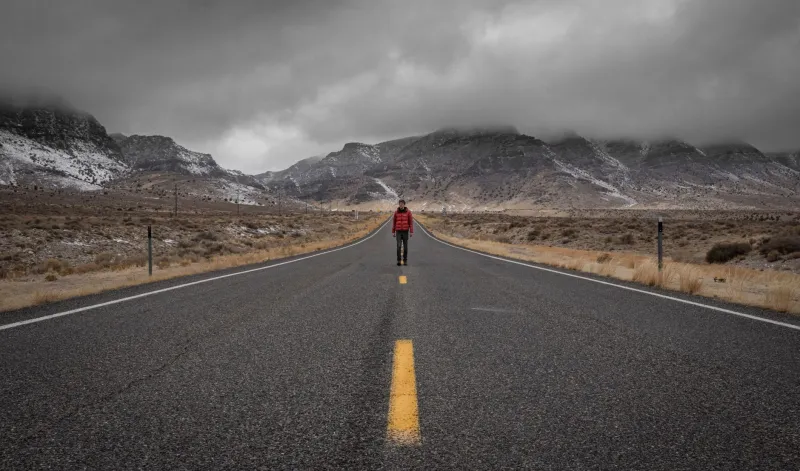
Hometowns are complicated. They give you your first language, your first sense of what's possible, your first idea of who you are. And sometimes — more often than the inspirational posters suggest — they also give you a ceiling. A quiet, invisible one, built not out of malice but out of familiarity. The people who knew you when you were seven have a hard time seeing you as anything else.
For some people, that ceiling is a minor inconvenience. For others, it's the thing they spend their whole lives trying to outgrow — and can't, until they leave.
These are five of them.
James Baldwin: Harlem Couldn't Hold What He Was Becoming
James Baldwin grew up in Harlem in the 1930s and '40s, in a household shaped by poverty, religion, and a stepfather whose ferocious anger left marks that Baldwin would spend his whole career writing through. He was brilliant, visibly so, and Harlem recognized that — but brilliance in a young Black man in mid-century America came with its own particular set of pressures.
Baldwin left for Paris in 1948, at twenty-four, with forty dollars in his pocket and no clear plan. He went because he needed distance — from America's racial violence, from the expectations of his community, from the version of himself that Harlem had already decided he was. In Paris, anonymous and broke, he wrote Go Tell It on the Mountain. He found, paradoxically, that he could only understand America — and write about it with the clarity that would make him one of its greatest prose stylists — from three thousand miles away.
He never fully came back. He lived between continents for the rest of his life, always the expatriate, always the outsider looking in. That displacement, painful as it was, became the source of his most penetrating work. You can't describe the water when you're swimming in it.
Zora Neale Hurston: Florida Gave Her the Material, New York Gave Her the Frame
Zora Neale Hurston was born in Notasulga, Alabama, and raised in Eatonville, Florida — one of the first incorporated Black townships in America. Eatonville gave her something extraordinary: a childhood in a community that wasn't defined by proximity to whiteness, a place where Black culture existed on its own terms, self-governing and proud.
But Eatonville also had limits. It was small, and the world Hurston was developing an appetite for — literature, anthropology, the full range of American intellectual life — wasn't available there. She left for Baltimore, then Washington, then New York, arriving in Harlem at the height of its cultural renaissance and immediately becoming one of its central figures.
What's remarkable about Hurston's trajectory is that leaving didn't make her forget where she came from — it made her able to see it. Her greatest novel, Their Eyes Were Watching God, is saturated with the language and landscape of Eatonville. She needed the distance of New York to look back at Florida with the eyes of an anthropologist and an artist simultaneously. The hometown gave her the material. The displacement gave her the frame.
Johnny Cash: Arkansas Put the Darkness In, Nashville Let It Out
Johnny Cash grew up in Dyess, Arkansas, a Depression-era farming community established by the federal government to resettle poor families. It was hard country in every sense — the land, the work, the poverty, the loss. His brother Jack died in a sawmill accident when Johnny was twelve, a wound that never fully closed.
Dyess gave Cash his darkness. It gave him the weight that would make his voice unlike anyone else's. But it couldn't give him a future. He left for Memphis after his Air Force service, then pushed toward Nashville, where the music industry was consolidating around a particular kind of polished country sound that had very little room for a man who sang like the bottom had fallen out of the world.
Nashville kept trying to smooth Cash down. He kept refusing. The tension between what the industry wanted and what Dyess had made him produced some of the most enduring recordings in American music — raw, morally complex, unflinching. He had to leave home to find the audience for what home had done to him.
Diane Arbus: Manhattan Couldn't Contain Her, But It Also Couldn't Let Her Go
Diane Arbus was born into a wealthy New York family — fur merchants, Fifth Avenue, the whole insulated world of mid-century Jewish upper-class Manhattan. She was supposed to fit into that world. She married young, worked in fashion photography with her husband, and lived, on the surface, exactly the life her background prescribed.
But Arbus was drawn to something her background had no category for. She wanted to photograph the people on the edges — circus performers, nudists, twins, drag queens, the residents of institutions that polite society preferred not to acknowledge. To do that work, she had to leave her world without physically leaving the city. She traded uptown for downtown, fashion for documentary, comfort for obsession.
Her displacement was social and psychological rather than geographical. She crossed invisible borders that her family and peers considered impassable. That crossing cost her — relationships, stability, eventually her mental health. But it produced a body of work that permanently changed what photography could be about. She had to become a stranger in her own city before she could see it clearly.
Bruce Lee: Seattle Gave Him a Start, but the World Was the Only Stage Big Enough
Bruce Lee arrived in Seattle at eighteen, sent by his family in Hong Kong to keep him out of trouble. He taught kung fu, washed dishes, studied philosophy at the University of Washington. Seattle was a beginning, but it was never going to be the whole story.
He moved to California, then tried Hollywood, where he ran into a wall that was both racial and professional: the industry had no framework for an Asian leading man. He was offered supporting roles, sidekick parts, the kind of work that confirmed rather than challenged the stereotypes he was trying to dismantle. He went back to Hong Kong, where he became the biggest movie star in Asia before Hollywood finally caught up.
The displacement was circular — he left one place that couldn't hold him, found his footing in another, and changed the first place's mind from a distance. He never got to fully enjoy the vindication. But the path he traced — from Seattle to LA to Hong Kong and back — became the template for every Asian American performer who came after him, navigating the same gaps between what the industry imagined and what they actually were.
The Distance That Makes You
There's no clean lesson in these five stories. Leaving home doesn't guarantee anything. It's painful, disorienting, and sometimes permanently costly. Baldwin never stopped grieving his exile. Arbus's crossing came with a price she ultimately couldn't survive.
But what these lives share is this: they all required a kind of space that their original communities couldn't provide. Not better communities, necessarily — just different ones. Ones that had room for something new.
Sometimes the greatest thing a hometown can do for you is make it impossible to stay.