Five Times America Almost Missed the Invention That Defined It
1. The Telephone: "An Interesting Novelty, But No Commercial Value"
In 1876, Alexander Graham Bell offered to sell his telephone patent to Western Union for $100,000. The company's response became legendary in business circles for all the wrong reasons: "This 'telephone' has too many shortcomings to be seriously considered as a means of communication. The device is inherently of no value to us."
 Photo: Alexander Graham Bell, via historicbios.com
Western Union's executives couldn't imagine why anyone would want to talk to someone they couldn't see, especially when the telegraph system worked perfectly well for sending messages. They viewed Bell's invention as a parlor trick—interesting for demonstrations, useless for business.
Bell, a Scottish immigrant who taught deaf students for a living, had no choice but to start his own company. Within two years, Western Union was desperately trying to develop their own telephone technology and eventually paid Bell's company $25 million to avoid a patent lawsuit. By 1880, there were 85,000 telephones in America. By 1900, there were 1.35 million.
The lesson? Sometimes the most transformative technologies are the ones that established players can't imagine anyone wanting.
2. The Personal Computer: "There Is No Reason Anyone Would Want a Computer in Their Home"
In 1977, Ken Olsen, founder of Digital Equipment Corporation and one of the most respected names in computing, made a prediction that would haunt him for decades: "There is no reason for any individual to have a computer in his home."
Olsen wasn't alone. IBM, the undisputed king of business computing, had studied the home computer market and concluded it was too small to matter. When young entrepreneurs like Steve Jobs and Steve Wozniak pitched their personal computer ideas to established tech companies, they were told that computers were serious business machines, not consumer products.
Even when the Apple II proved there was a market for home computers, industry giants remained skeptical. An IBM executive famously dismissed the personal computer market as "a small niche that might eventually sell 250,000 units worldwide."
The reality? By 1982, Time magazine named the personal computer its "Machine of the Year." By 1985, Americans were buying more than 2 million personal computers annually. The industry that "serious" computer companies had dismissed as a hobby became a trillion-dollar market that transformed how Americans work, learn, and communicate.
3. The Internet: "A Waste of Time" That Almost Got Canceled
In 1995, Clifford Stoll, an astronomer and computer expert, wrote an article for Newsweek titled "The Internet? Bah!" His prediction was confident: "The truth is no online database will replace your daily newspaper, no CD-ROM can take the place of a competent teacher, and no computer network will change the way government works."
Stoll wasn't some random critic—he was an early internet user who simply couldn't see how it would scale beyond academic and government use. More concerning, neither could the people funding it.
Throughout the 1980s, the Defense Department repeatedly considered shutting down ARPANET, the internet's predecessor, viewing it as an expensive experiment that had outlived its usefulness. Congressional budget committees questioned why taxpayers should fund a network that seemed to exist mainly so researchers could send each other messages.
The internet survived largely because of a small group of computer scientists who kept fighting for funding, arguing that the network had potential beyond what anyone could currently imagine. They were right, but they came close to losing the argument multiple times.
Today, of course, the internet isn't just part of American life—it's the foundation for everything from commerce to communication to entertainment. The "waste of time" that almost got canceled became the platform that would launch Amazon, Google, Facebook, and countless other companies that now define American business.
4. The Automobile: "A Fad That Will Never Replace the Horse"
In 1899, the president of the Michigan Savings Bank advised Henry Ford's lawyer not to invest in Ford's automobile company, explaining: "The horse is here to stay, but the automobile is only a novelty—a fad."
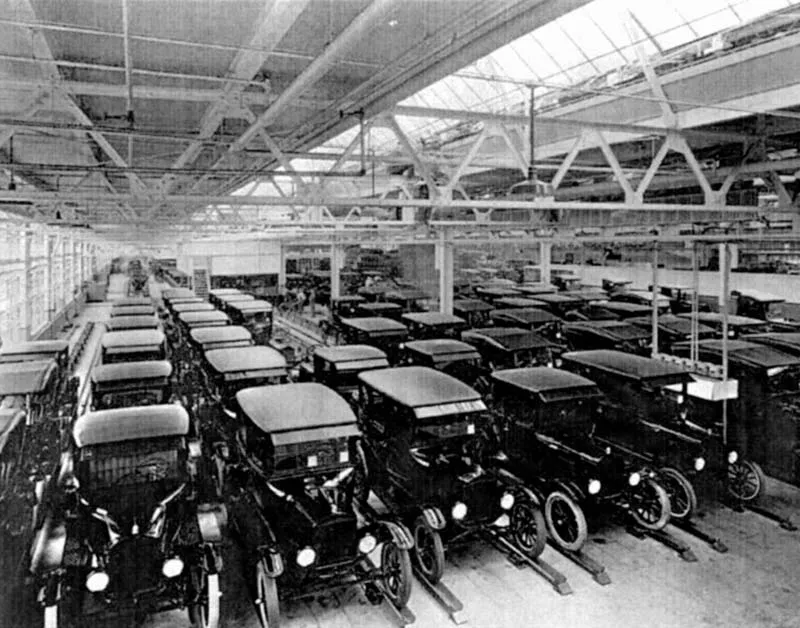 Photo: Henry Ford, via henryfordassemblylinebyrobert.weebly.com
The banker wasn't alone in his skepticism. Early automobiles were expensive, unreliable, and required a level of mechanical knowledge that most Americans didn't possess. They scared horses, broke down constantly, and couldn't travel many places that horses could go.
Even some early automotive pioneers had doubts. In 1903, the president of the Association of Licensed Automobile Manufacturers predicted that the automobile market would soon be saturated, noting that "the ordinary man" would never be able to afford a car.
Ford's innovation wasn't just building cars—it was believing that ordinary Americans would want them if they were affordable and reliable. His assembly line methods made the Model T cheap enough for his own workers to buy, and his dealer network made cars accessible in small towns across America.
By 1920, there were 8 million cars on American roads. By 1930, there were 23 million. The "fad" had become the foundation of American mobility, transforming everything from where people lived to how cities were designed.
5. The Airplane: "Flying Machines Are Impossible"
Just nine days before the Wright Brothers' first flight at Kitty Hawk, The New York Times published an article explaining why human flight was impossible: "To build a flying machine would require the combined and continuous efforts of mathematicians and mechanicians for one million to ten million years."
The Times wasn't alone in its skepticism. Lord Kelvin, one of Britain's most respected scientists, had declared in 1895 that "heavier-than-air flying machines are impossible." The U.S. War Department had stopped funding flying machine experiments after a series of failures, concluding that the whole enterprise was a waste of money.
Even after the Wright Brothers succeeded, many experts remained unconvinced. The Scientific American initially suggested that the flights at Kitty Hawk were hoaxes, and it took years for the aviation community to accept that the Wright Brothers had actually solved the problem of powered flight.
The Wright Brothers succeeded partly because they were outsiders—bicycle mechanics from Ohio who approached the problem differently than the engineers and scientists who had been trying to crack it for decades. They didn't have the resources of established research institutions, but they also didn't have the preconceptions that had limited other inventors.
The Pattern of Near Misses
These five stories share a common thread: in each case, established institutions failed to recognize transformative potential, while individual innovators persisted despite official skepticism. The telephone, personal computer, internet, automobile, and airplane all survived their early years not because of institutional support, but because stubborn individuals refused to accept that their ideas were impossible.
The pattern suggests something important about how innovation actually works in America. The most transformative technologies often come not from the companies and institutions best positioned to develop them, but from outsiders who see possibilities that insiders can't imagine.
Perhaps that's the most American thing of all: the belief that the next great breakthrough is just as likely to come from someone's garage as from a corporate research lab, and that the ideas everyone says are impossible might just be the ones that change everything.