The Janitor's Blueprint: How a Self-Taught Inventor Quietly Transformed American Industry
The Night Shift Genius
Every evening at 6 PM, while the engineers packed up their briefcases and headed home to suburban dinners, Frank Zamboni pushed his mop bucket through the corridors of the Paramount Iceland skating rink in Paramount, California. It was 1942, and the 41-year-old son of Italian immigrants had been cleaning ice rinks, fixing refrigeration units, and doing whatever odd jobs kept food on his family's table.
But Frank had a problem that wouldn't let him sleep.
Resurfacing the ice between skating sessions took an hour and a half of backbreaking labor. Three or four workers would scrape the surface by hand, add thin layers of water, and smooth everything with squeegees and towels. The process was exhausting, expensive, and kept customers waiting. Frank watched this ritual every night, and his mechanical mind wouldn't stop turning.
What the credentialed refrigeration engineers couldn't see, Frank saw with perfect clarity: there had to be a better way.
Building Solutions from Scrap Metal
Frank's workshop wasn't a sterile laboratory or a well-funded research facility. It was a cluttered garage behind the ice rink, filled with salvaged parts, discarded machinery, and the kind of organized chaos that only makes sense to its creator. While other inventors relied on theoretical knowledge and expensive prototypes, Frank built his solutions from whatever he could find.
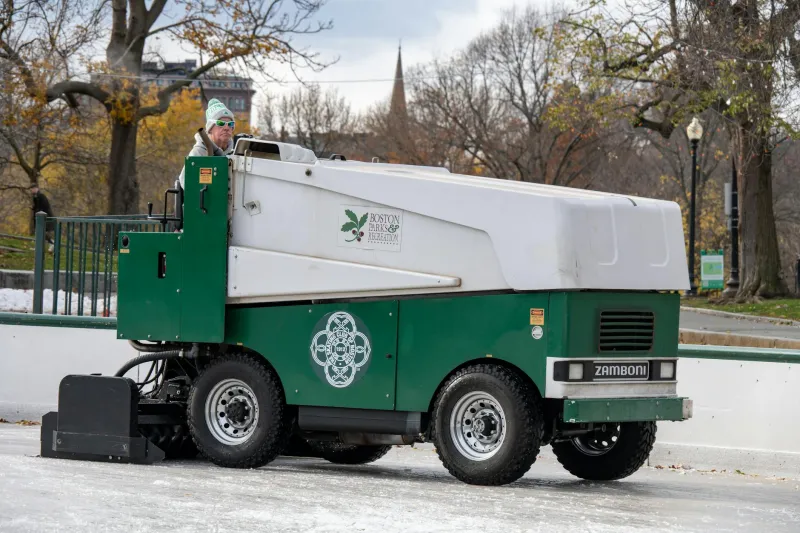
His first ice resurfacing machine looked like something from a mad scientist's fever dream. He mounted a tractor chassis with a blade to scrape the ice, a tank to hold hot water, a mechanism to spread the water evenly, and a squeegee system to smooth the surface. The entire contraption was powered by surplus military parts he'd bought for pennies on the dollar.
It worked.
What took four men ninety minutes to accomplish, Frank's machine could do in fifteen minutes with a single operator. The skating rink's profits soared as customers no longer had to wait through lengthy resurfacing breaks.
The Patent That Changed Everything
Word spread through the tight-knit community of ice rink operators. Arena managers from across California made pilgrimages to Paramount to see Frank's invention in action. They wanted machines of their own, but Frank was too busy running the rink and refining his design to think about mass production.
That changed when the Sonja Henie Ice Revue came to town in 1949. The traveling ice show's management was so impressed with Frank's machine that they ordered one for their tour. Suddenly, Frank found himself in the manufacturing business, building custom ice resurfacing machines in his garage workshop.
By 1953, Frank had incorporated the Frank J. Zamboni Company and received his first patent. The machine that would eventually bear his name was becoming the industry standard, not because it emerged from a corporate research lab, but because it solved a real problem that Frank lived with every single day.
The Mechanic's Advantage
Frank's success reveals something profound about innovation in American industry. While engineers with advanced degrees approached problems through theoretical frameworks and computer models, Frank approached them through intimate familiarity. He knew exactly how long it took to resurface ice because he'd done it thousands of times. He understood the physical strain because his back ached from the work. He recognized the inefficiencies because he'd watched money walk out the door during every lengthy break.
This wasn't just about ice rinks. Frank's mechanical instincts led him to innovations in refrigeration, concrete mixing, and astroturf cleaning. Each invention emerged from his direct experience with industrial problems that seemed intractable to others.
The man who never took an engineering course held over fifteen patents by the time he died in 1988.
Beyond the Rink
The Zamboni machine became more than just an industrial tool—it became an American icon. Hockey fans cheered its appearance between periods. Children dreamed of driving the slow-moving machine around the ice. The Zamboni entered popular culture, referenced in movies, television shows, and comedy routines.
But Frank's real legacy lies in what his story tells us about American innovation. The greatest breakthroughs don't always come from the most obvious places. They come from people who see problems differently because they live with them differently.
Today, the Zamboni Company continues to dominate the ice resurfacing market that Frank created from nothing. Professional hockey leagues, Olympic venues, and neighborhood skating rinks all depend on machines that trace their lineage back to that cluttered garage in Paramount, California.
The Blueprint for Unlikely Success
Frank Zamboni's story offers a different model for thinking about expertise and innovation. While the business world often celebrates the brilliant theorist or the visionary entrepreneur, Frank represents something equally valuable: the practical genius who sees solutions because he lives with problems.
His path from janitor to industry transformer wasn't accidental. It was the result of curiosity applied to real-world challenges, persistence in the face of skepticism, and the willingness to build something better with whatever materials were at hand.
In an era when innovation is often associated with Silicon Valley startups and billion-dollar research budgets, Frank's garage workshop reminds us that transformative ideas can emerge from the most unexpected places. Sometimes the person closest to the problem is the one best positioned to solve it.
The next time you watch that slow-moving machine circle an ice rink, remember Frank Zamboni—the janitor whose blueprint for success was written not in boardrooms or laboratories, but in the practical wisdom of someone who simply refused to accept that things couldn't be better.